 |
| Although those who are intuitive feel that they can solve wider problems, they often fail to realize the reality. On the other hand, sensors are pragmatic. |
Wednesday, November 27, 2013
Carl Jung's Theory: Intuitive/Sensing
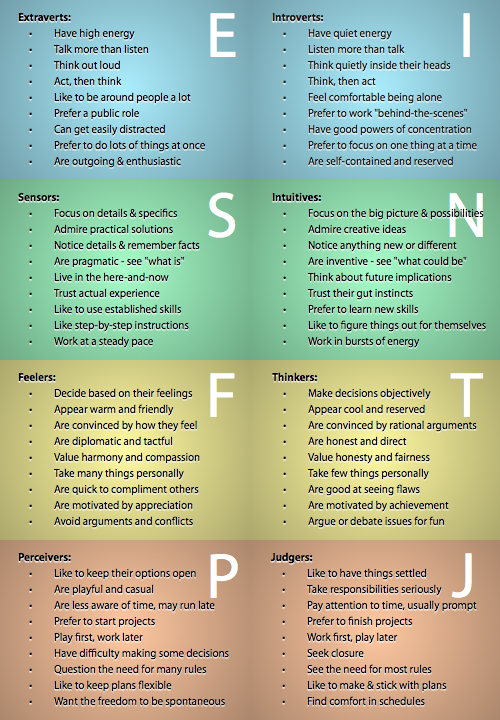
In my previous blog post, I wrote about the first part of Carl Jung's theory which is introversion and extroversion. Now, we are at the second part of the theory. It tells you how a person processes data. The two terms used to describe this are intuitive and sensing. A person who is intuitive is an abstract thinker. Often times, they read "between the lines". They typically focus on the future and the possibilities it beholds. Usually, an intuitive person likes to think a problem through rather than actually working on it right away. To solve a problem, they try to figure out what works best by thinking of different solutions. They like to work with new problems. Typically, they like to see the big picture and then the details. This can be good, however sometimes it can turn out to be a bad thing. This is because intuitive people sometimes focus so much on the possibilities that they forget to try to make it a reality. While, people that prefer sensing are the opposite. Those people look at things in a literal way by using their five senses of hearing, looking, feeling, touching, and smelling. They focus more on the facts, and then the big picture. At times, this could be a bad thing, because by focusing too much on the facts, they might miss out on new opportunities that await them. Additionally, they are a pragmatic, and trust experience more. Based off of my test results, I am an intuitive person. I am more theoretical. Often times in whatever I do, I usually think creatively. I feel that life would be boring, if there was no creativity. Sometimes, when I have to do a group project, my ideas come out to be far-fetched. I have got try my best to think of ideas that can actually come true. Sometimes, this can be difficult. Usually, when I have an idea that I really like out of my many other ideas, I want to start right away. Lately, I've been doing better in being slightly more realistic in my proposed solutions for problems. I have a friend who completely prefers sensing. She notices details and is more aware of her surroundings than I am. However, sometimes she uses her past experiences to solve problems. The issue with that is the solution to previous problems might not work again. Overall, I've noticed that intuitive people and those who have a preference for sensing can help each other out. The pros and cons of each type can balance if they work together cooperatively. In next post, I plan on describing the third part of Jung's theory.

Carl Jung's Theory: Introversion/Extraversion
In Carl Jung's theory, the first part out of the four, determines whether the individual is introverted or extroverted. Often times, this part is considered to be the most important part of the four. This part basically tells you where you get your energy and where you put your attention. Introverts are people who often tend to focus on internal thoughts. Often times they feel a need to "recharge" after socializing with people. Introverts are also quiet, reserved, and more sociable around people they know well. Introverts typically have a small group of friends. On the other hand, extroverts are the opposite. Extroverts tend to try to find external stimulation. Extraverts usually like places such as parties where they get energized by socializing. Also, they are more likely to take risks compared to introverts. Being an introvert myself with extroverted friends. I've noticed that these things are true. As an introvert, I have a smaller group of friends who I care a lot about. Often times, when I am introduced to new people, I stay quiet. I want to talk to them, but often times I'm not sure what I should talk about. I prefer to to know a few people well. I am a shy introvert. Many people have this misconception that being shy and introverted are the same. However, this is not true. According to Susan Cain, "Shyness is the fear of negative judgment, and introversion is a preference for quiet, minimally stimulating environments". She goes on to say, "Some psychologists map the two tendencies on vertical and horizontal axes, with the introvert-extrovert spectrum on the horizontal axis, and the anxious-stable spectrum on the vertical. With this model, you end up with four quadrants of personality types: calm extroverts, anxious (or impulsive) extroverts, calm introverts, and anxious introverts". By dividing the extroversion and I introversion scale, it makes it easier to understand how there is no one who is a hundred percent introverted or extroverted. According to Carl Jung, "There is no such thing as a pure introvert or pure extrovert. Such a person would be in a lunatic asylum". In next post, I hope to describe the second part of the theory which is intuitive and sensing.
 |
| This picture describes how I feel introverts and extroverts are like. |
 |
| When given the chance to be alone, introverts and extraverts feel differently about it as shown above. |
Thursday, October 31, 2013
Carl Jung's Theory: A Preview
Carl Jung (1875-1961) is a famous psychologist who had invented the sixteen personality types. The sixteen personality types are a mix of four pairs with one component of each pair being prominent: introversion/extroversion, intuitive/structured, thinking/feeling, and perceiving/ judging. When one component of each pair is mixed with the other ones it creates sixteen different personality types. Everyone has one of those sixteen types. There is a test you could take to figure out which one of these you fit in. These sixteen types are divided further into four groups. The four groups are rational, guardian, idealist, and artisans. I will explain more in my upcoming posts.
Four Temperaments (Four Humors)
The four temperaments is actually an an ancient theory. No one really knows who or where this theory was created. It is believed to be created around Ancient Egypt or Mesopotamia. These theory has been developed over time. Presumably, the first person to attempt to develope this theory was Hippocrates (460-370 BCE). Hippocrates had made this theory become more of a medical theory. He believed that the amount of body fluids (also called humors) would cause certain human moods, emotions, and behaviors to occur. The body fluids were yellow bile, black bile, blood, and phlegm. Following Hippocrates, Galen had created the first typology of the temperaments by using the Four Elements (earth, water. air and fire). After Galen, Avicenna (980-1037 AD) and Nicholus Culpeper (1616-1654) had both extended the theory to relate to personalities and physiognomies. Today, these four temperament types are called sanguine, choleric, melancholic, and phlegmatic. People who are of the sanguine temperament tend to be socialable and pleasure seeking. They are talkative, but not shy. Many times they believe that the things they do are right, however they may lack confidence. People of the choleric temperament are ambitious and leader like due to their aggression, energy and passion that they contain. However, if they do fail a goal, they can go into depression. Next, people who have the melancholic temperament are introverted and think a lot which causes them to be cautious of everything. These type of people typically are perfectionist. Yet, sometimes they're so into an activity, that they can forget other issues around them. Finally, people of the phlegmatic temperament are calm, and quiet. These type of people are able to view the world around them without getting involved which makes them good diplomats. At times, they can be passive-aggressive.
I've noticed that these are similar to Jung's sixteen personality types. The main difference between the both of them is that personality types can change, while temperaments cannot. Temperaments in form or another are the same at all times throughout the entire human's life. Perhaps, this is where Jung got his idea for his sixteen personality types. For anyone who would like to know what their temperament is they can take the test.

Aristotle's Theory
Aristotle (384-322 BCE) was one of Plato's students. Additionally, he was Alexander the Great's teacher. Similar to Plato's teachings, Aristotle points out that knowledge is important. However, knowledge of the soul is the most important. Aristotle believes that all living things have a soul. He divides his theory of psyche into three different faculties mainly upon judging human beings, but it could be applied to other living things, too. In order of importance, from Aristotle's view, they are intellectual, perceptual, and nutritive. Intellectual is Aristotle belief that this was unique to humans. He even believed that it is like a sensory organ. It should not be shown as equal to the body. Additonally, intellect has two types: passive and active intellect. Passive intellect is knowledge one has before experience. While, active intellect is knowledge one gains after experience. Perceptual is how the mind comprehends details of sensory. Finally, nutritive is how the human's basic desires are meets its bodily needs. In the end, Aristotle had believed in three distinct faculties of psyche: intellectual, perceptual, and nutritive.
I, for one, am strong believer of Aristotle's theory. He shows that knowledge is unique. Additionally, he presents that intellect, perception, and nutrition are three faculties of psyche that having varying importance. However, I feel that these are all equal. Mainly, due to the fact, that I have noticed these three faculties are dependent among each other. To have intellect, one must have an accurate perception of the world around. To have an accurate perception, one must be healthy enough to be able to use all their senses. To gain nutrition, one must have some sort of intellect on what kind of things their body needs. In order find the things necessary to keep one alive, one must have a great perception. In a way, this is a cycle. However, this cycle can go out of order. Additionally, all three of these could be happening at the same time. Although I believe in Aristotle's theory, I feel that intellect is not the highest faculty. Intellect is dependent on perception and nutrition. In one way or another, each of these faculties are dependent upon each other which is why I believe no one faculty is better than the other.

I, for one, am strong believer of Aristotle's theory. He shows that knowledge is unique. Additionally, he presents that intellect, perception, and nutrition are three faculties of psyche that having varying importance. However, I feel that these are all equal. Mainly, due to the fact, that I have noticed these three faculties are dependent among each other. To have intellect, one must have an accurate perception of the world around. To have an accurate perception, one must be healthy enough to be able to use all their senses. To gain nutrition, one must have some sort of intellect on what kind of things their body needs. In order find the things necessary to keep one alive, one must have a great perception. In a way, this is a cycle. However, this cycle can go out of order. Additionally, all three of these could be happening at the same time. Although I believe in Aristotle's theory, I feel that intellect is not the highest faculty. Intellect is dependent on perception and nutrition. In one way or another, each of these faculties are dependent upon each other which is why I believe no one faculty is better than the other.

These three types are parts of the human soul
according to Aristotle. It's just that they are named differently.
Rational is intellectual. Vegetative is nutrition. Appetitive is perception.
Wednesday, October 30, 2013
Plato's Theory Part 2
In my previous post regarding Plato's theory, I revealed the first part of his theory. In review, I basically spoke about how Plato felt the soul is the essence of humans. The soul is independent, however it requires the help of three parts: emotion, reason, and appetite. This may have helped Plato form the second part of his theory. Plato believed that there are five distinct regimes that were mainly used to classify types of societies or governments, but it could also be used to describe people. They are Aristocracy also known as Kingship, Timocracy, Oligarchy, Democracy and Tyranny. Each of these categories describe what a person's main focus on life is. Aristocracy is that life is quest for knowledge. A person with an Aristocratic personality is like a philosopher. It is a person who if put in power, would not abuse the power he beholds. Instead, he or she would use it to help out all citizens. These kind of people are able to use their love for knowledge to make their desire for good come true. Next, Timocracy is the belief that life is a quest for honor and fame. These type of people tend to be interested in activities involving money. They also are typically obedient towards authority. Following Timocracy is Oligarchy which is the view that life is the quest of money and material wealth. After this comes Democracy which is the belief that life is the journey of short-time pleasure. Finally, Tyranny is that life is the journey of safety and survival. Overall, these five different categories are a part of the human soul. It's just that these are not all in equal amounts. The ones that are a bigger part will give a bigger influence in which it will affect the opinions and interests we have.
Personally, out of all of these five categories, I believe in Aristocracy. I feel that knowledge really is power. If a person has knowledge, they can achieve anything. In society today, people with an associates degree get paid less than people that have a doctorate degree. By being paid more, they can buy whatever they want. Whatever the person buys can be for a short-time pleasure. A person who is knowledgeable in any topic will be respected. More people will listen to them compared to a person who barely knows anything about the given topic. Their honor and fame is automatically given to them. While, safety and survival tips and tricks can be learned from books, computer, or even other people. By learning such things, the life expectancy of a person can be higher. I have realized that even though I believe in knowledge being the quest of life, I also have small beliefs in the other categories too. All these categories appear to be dependent among each other.

Personally, out of all of these five categories, I believe in Aristocracy. I feel that knowledge really is power. If a person has knowledge, they can achieve anything. In society today, people with an associates degree get paid less than people that have a doctorate degree. By being paid more, they can buy whatever they want. Whatever the person buys can be for a short-time pleasure. A person who is knowledgeable in any topic will be respected. More people will listen to them compared to a person who barely knows anything about the given topic. Their honor and fame is automatically given to them. While, safety and survival tips and tricks can be learned from books, computer, or even other people. By learning such things, the life expectancy of a person can be higher. I have realized that even though I believe in knowledge being the quest of life, I also have small beliefs in the other categories too. All these categories appear to be dependent among each other.
The Five Types
Friday, October 18, 2013
My Research
Just recently, I've started to look for sources other than the Internet. At the library, I found several books regarding Jung's theory. The book that I felt was the best was Jung's Map of the Soul by Murray Stein. The book is concise and interesting. I'm amazed at how well Jung studied the concept of ego and consciousness. According to the book, Jung believes, "the ego forms the critical center of consciousness and in fact determines to a large extent which contents remain within the realm of consciousness and which ones drop away into the unconscious" (Stein 18). Based on this information, it shows how determined Jung was to unlock the mysteries of the world of psychology. Jung may have formed his six personality types theory off of this knowledge. Overall, this book is splendid. I recommend this book to everyone interested in learning more about Jung.
Subscribe to:
Posts (Atom)